Another compliance issue has been introduced for businesses in Pakistan in the Finance Act 2026. It is focusing on one line item that always been in most companies.
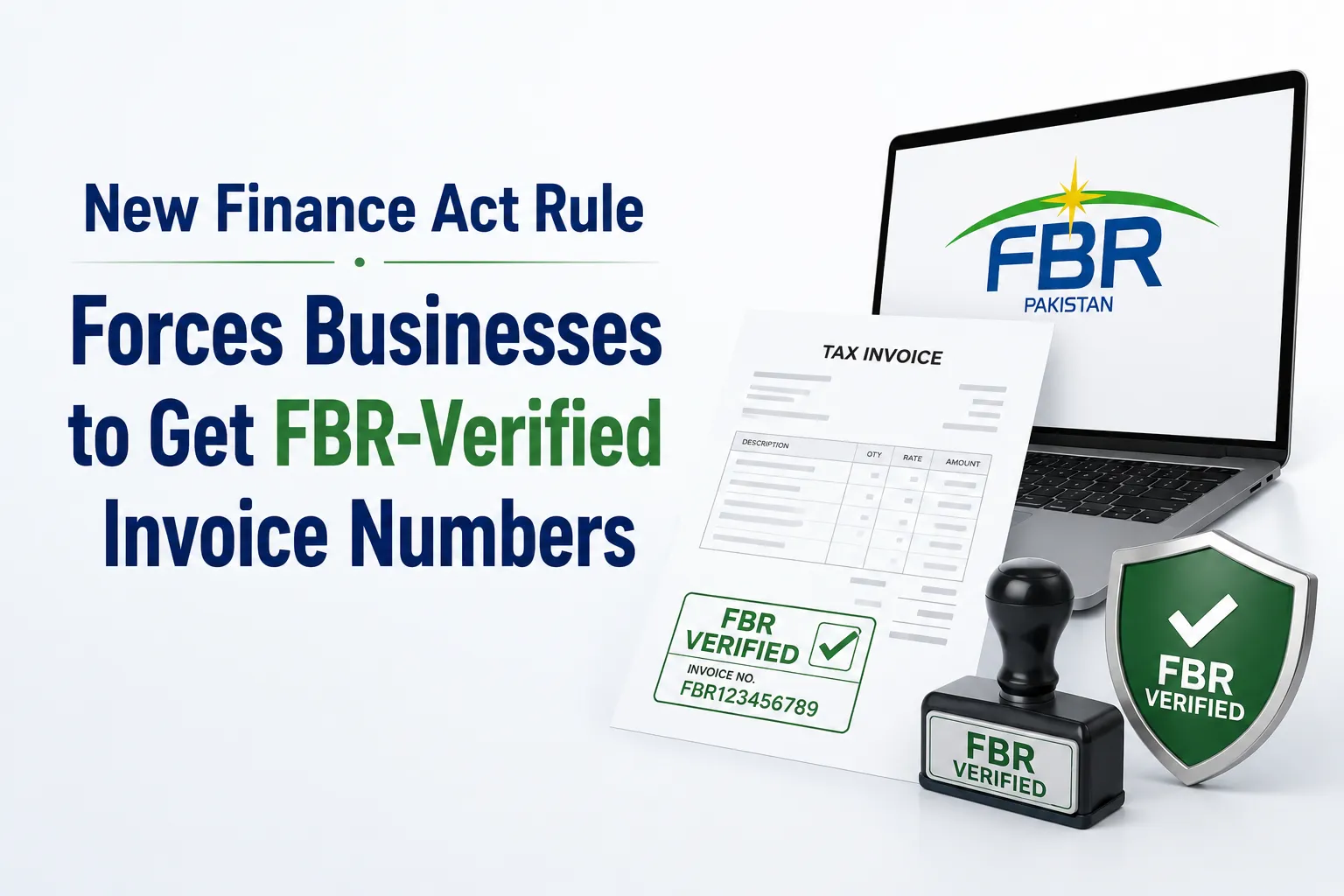
The new Federal Excise Act amendment requires a person registered under the Federal Excise Act to issue an invoice (including an advance receipt invoice) with a verifiable and unique Federal Excise Act invoice number. It is the case at the time goods are cleared or sold, or when services are rendered. It applies to zero rated goods!
There are certain details which should be included in every qualifying invoice, either in Urdu or English. It includes the Seller/Buyer name, address, registration number and the invoice date. There shall also be a description and a quantity of goods or a description of services.
The invoice should also contain the following information. Value without excise duty, Value with excise duty and Value on the invoice. These two fields are designed to be used in conjunction to ensure complete traceability to each party in any transaction.
Importantly, the requirement not be immediate for all. The law empowers the FBR to inform any particular persons or classes of persons to issue advance receipt invoice in compliance with a specific system. The condition of the unique invoice number only applies from a date which is formally notified by the Board.
New development is part of a broader plan by FBR to move towards e-invoicing in real-time and valid form. Previously, FBR had implemented an online facility for verifying the invoices on its website. It allows buyers to go straight to the business to verify if an invoice is sent to FBR system.
FBR has asked businesses and professionals to send real-time verifiable electronic invoice in respect of every taxable supply/service. These records have to be kept electronically for 6 years according to Section 174 of Income Tax Ordinance.
Notified businesses are asked to go further with draft rules under SRO 288(I)/2026. They leave FBR the option of making the point of sale integration and real-time QR-coded invoices mandatory. A novel addition in Pakistan tax collection is that CCTV cameras are also allowed at points of sale in the first instance.
Inland Revenue Enforcement squads would be patrolling business premises and making instant verification of compliance under draft rules. The absence of QR codes or FBR invoice numbers the officers could make estimates of unaccounted sales.
| What is Required | Detail |
|---|---|
| Unique FBR invoice number | Verifiable, issued before or at time of sale |
| Format | Urdu or English |
| Applies to | Registered persons under the Excise Act, including zero-rated goods |
| Record retention | 6 years (Section 174, Income Tax Ordinance) |
| Enforcement start | To be notified by FBR |
| First-default penalty (non-integration) | PKR 500,000, escalating up to PKR 3,000,00 |
There are essentially two ways to get access to FBR system. Businesses can integrate at no cost via the Government own integration platform, PRAL. They can also use a licensed third party integrator who submits invoices via FBR official gateway.
The draft licensing framework stipulates that no entity would be allowed to tie up a business to FBR systems without a license. Such license shall be issued by the Board, shall be for a five-year term and shall not be transferable.
The consequences for non-compliance are nothing to be taken lightly. If the first time a failure to integrate happens, then a penalty of PKR 500,000 will be levied under the Sales Tax Act 1990 as amended by the Finance Act 2024. Reports suggest this escalates to PKR 1,000,000, then PKR 2,000,000, and up to PKR 3,000,000 for repeat defaults.
According to draft income-tax regulations, non-compliant businesses may be subject to action under the Income Tax Ordinance Section 182. Documentation requirements for related parties are also tightened in the Finance Act.
One such clause now bars 50 percent of the expenses that can be claimed in a single bill that exceeds. If payment was received via bank or digital channels, 200,000. It is a policy to specifically encourage more transactions to be put through traceable, documented payments.
To businesses that are still catching up, it is all about the simplicity. Check the eligibility of your business in a notified category, and register with PRAL or a licensed integrator before the enforcement date.
Ensure that your invoicing systems are updated to include the correct fields that are now required by the law. Companies should keep a close watch on official notifications since the FBR has the authority to give notification separately about the date from which the rule starts to apply and the businesses covered by the rule.