
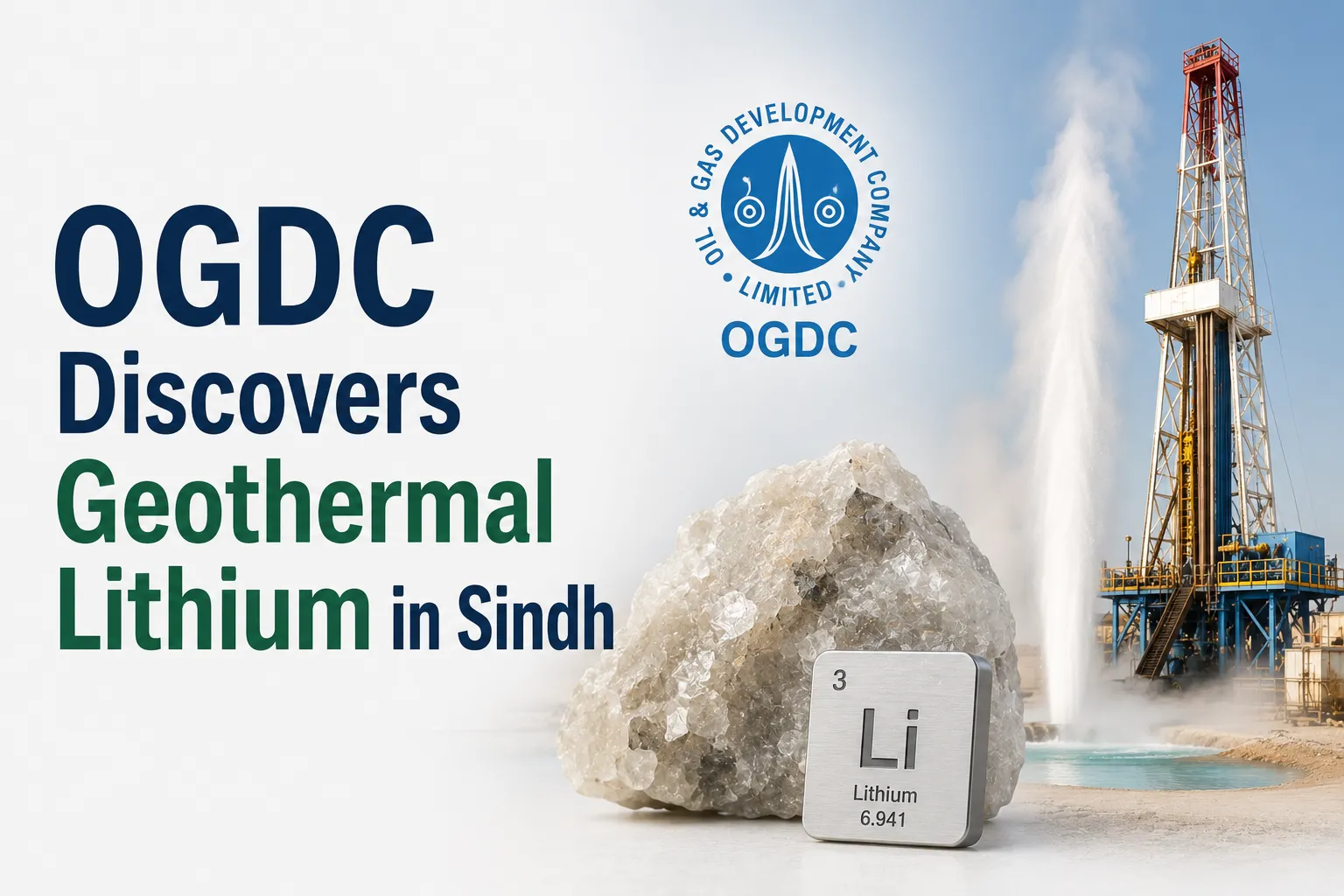
Pakistan has a important stride towards the global critical minerals race. For the first time in the country, oil and Gas Development Company Limited (OGDC) has confirmed the presence of lithium in the formation water in Sindh.
The lithium concentrations were similar to some of the world highest lithium content geothermal brines. This places the early results of Pakistan on par with projects already commercially developed in Europe and North America.
Advanced geochemical analysis led to the discovery. The officials studied formation water of the successfully tested high temperature geothermal well under the pilot program for geothermal development by the OGDC in Sindh which was termed as “produced” formation water.
Salty water that is contained in the rocks underground for millions of years is formation water. It is associated with oil, gas and trace minerals such as lithium.
Water is extracted to the surface during the drilling process, and is known as produced water. In addition to being used for hard rock mining, it is now being used more and more as a brine source for lithium extraction by companies around the world.
It is more sustainable way of mining than conventional techniques. In the process of geothermal brine extraction, companies can extract lithium from the ground, and at the same time produce geothermal energy, which reduces the environmental impact of the extraction process.
Lithium is at the heart of the world clean energy transition. About 80% of all lithium is used in electric vehicle batteries, while the remaining 20% is used in other industries, including aerospace and defence, consumer electronics, medicine and grid-scale energy storage.
To support the next phase, OGDC is collaborating with the top international consultants. To introduce international expertise and to ensure that future evaluations of resources are conducted in accordance with international best practices and investment standards.
But OGDC has already mapped out its next steps. The company intends to conduct detailed “brine chemistry profiling”, “resource confirmation” studies, and commercial evaluations in accordance with internationally accepted standards.
There has been a certain caution on the officials part in not raising expectations in the early stages. The discovery was deemed to be promising but more technical work would need to be done to establish the true size and marketability of the resource.
If the reserves of these commercial mines are ever determined to be recoverable, it could mean big consequences. It would be a true diversification step by OGDC, which has traditionally been a firm that has been dominated by conventional oil and gas exploration.
The discovery, is a sign of Pakistan increased focus on geothermal energy and other critical minerals as supporting industries. Even the fact that it is a preliminary discovery makes the case for the importance of this discovery in Chile, where lithium demand is expected to rise significantly over the next few years.
The discovery is still in the confirmation stage and not commercial reserves. For a country that has virtually untapped subsurface resources, it is a promising start in an industry that most had never expected to have anything to do with Pakistan.