

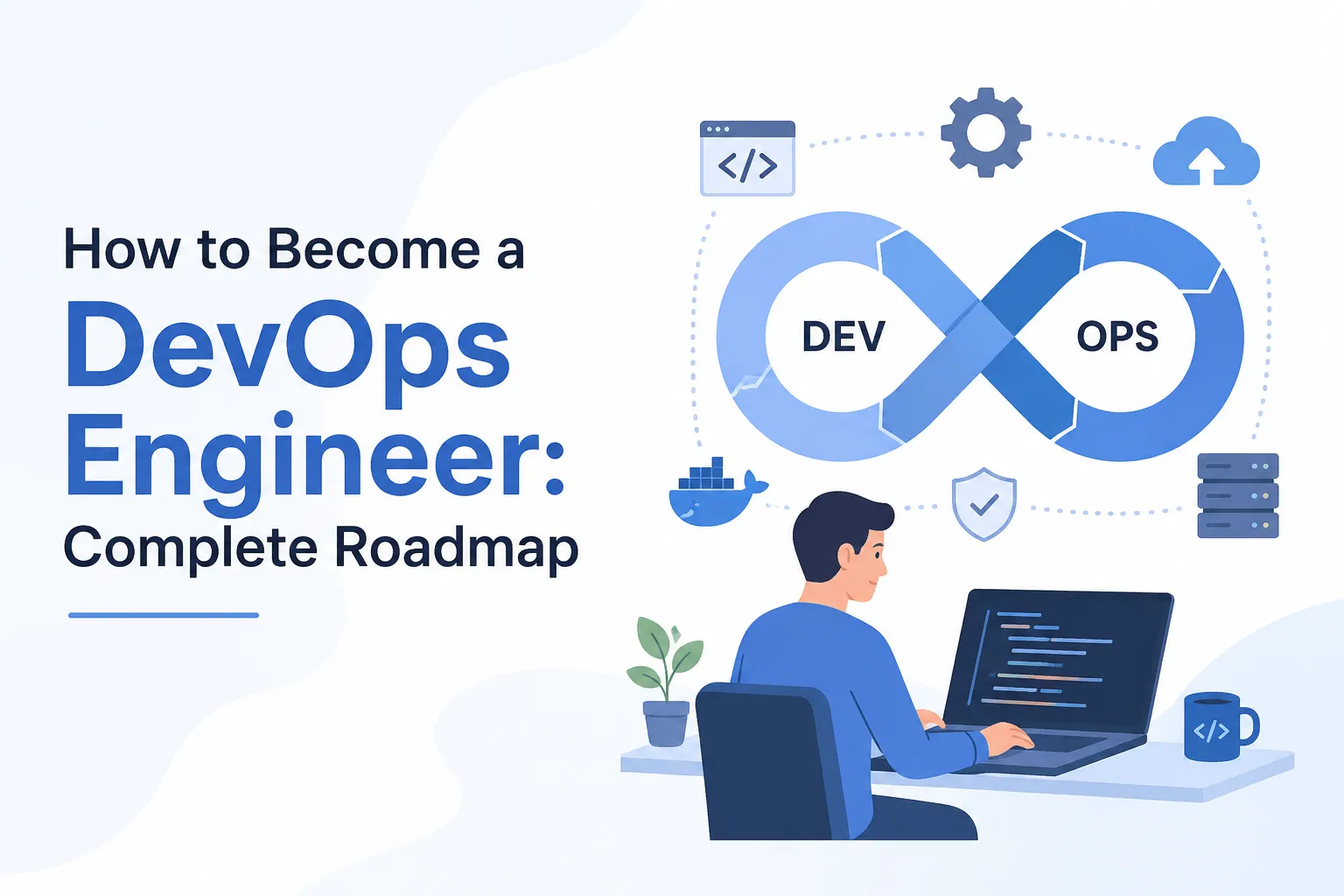
For all intents and purposes, DevOps is one of the hottest markets in tech today, the skill set it demands is not quite as as some other. There is no need to make guesses about what to learn. All it takes is to learn it in the right sequence.
Here is a realistic, step-by-step roadmap covering exactly that.
What is a DevOps Engineer anyway?
DevOps is an amalgamation of development and operations processes that supports teams to deliver software quicker and more consistently. A DevOps engineer role is to automate infrastructure, minimize deployment failures, enhance system reliability, and assist development teams in releasing code without causing any security issues.
Overall demand for this role has remained robust and is expected to continue to grow into 2026, with the shift to cloud-native systems, quicker release cycles, and more and more, AI-aided operations playing a significant role. There are tens of thousands of DevOps positions active on job sites all over the world.
Step 1: Build a Strong Linux Foundation
This is not an option – most production servers are on Linux. Comfort working with the command line, file permissions, process management, and basic troubleshooting.
Take the time to read this before moving on. The following concepts, such as working with containers and cloud infrastructure that take it for granted, cause issues when you first start building your Linux skills.
Step 2: Learn Scripting and Programming
There are two languages that keep appearing in DevOps bash and python. For small automation and system jobs, Bash is used, and for larger automation and tooling, Python is generally the preferred language.
A few DevOps engineers also learn Ruby or Perl, which are less widespread than Python and Bash. It is no longer enough to simply avoid a scripting/ coding round in the technical interview process for DevOps positions.
Step 3: Learn Git and Version Control.
You will be collaborating with others and Git is the tool of choice. Understand branching, merging, pull requests, and how to handle conflicts, which eventually will become intuitive once you are on different CI/CD pipelines.
In addition to the skill itself, having a great profile on GitHub can serve as a portfolio. Employers often check out your public projects and commit history, along with your resume.
Step 4: Learn Cloud Fundamentals
Modern DevOps work revolves around cloud platforms. Choose a single major provider (AWS, Azure, or Google Cloud) and dive deep instead of getting your head around all three in the beginning.
Prioritize core services compute, storage, networking, identity and access management. After you learn the basics of one platform, you will find it much simpler to learn.
Step 5: Get Comfortable with Docker and Containerization
Modern applications are distributed applications, a frontend, a backend, a database and a file server, all of these may be running on different infrastructure. It is a very big problem for deployment and consistency that containers resolve.
Discover how to create Docker images and run them in containers, and why containerization has emerged as the holy grail for application packaging and shipping. This step is a direct prerequisite to Kubernetes, which is built on these concepts.
Step 6: Learn CI/CD Pipelines
Continuous Integration and Continuous Delivery pipelines are processes that automate moving code from a developer commit to production. Here are usually some tools such as Jenkins and GitLab CI.
Construct your own pipeline, rather than read about it. Have a project that does testing and deployment of code for every commit as this is the type of hands-on skill interviewers will inquire.
Step 7: Orchestrate with Kubernetes
Mastering individual containers, Kubernetes orchestrates them at scale, scales them, and provides networking and failover management at the cluster level automatically. This is one of the more difficult sections of the roadmap, and it will need to be done seriously and not in a hurry.
APIs well can be quite useful, as much of Kubernetes is based on API-driven communication between services.
Step 8: Learn Infrastructure as Code
It is the de facto standard tool for using a code- as opposed to manual provisioning tool for infrastructure. It enables teams to version, review and repeat infrastructure changes as they do with their application code.
Terraform is used in conjunction with configuration management tools such as Ansible or Puppet, which are used for managing the ongoing configuration of the servers after provisioning.
Step 9: Build Observability and Security Skills
The other parts of the picture are monitoring, logging and alerting – if your deployments are automated, you need to be able to see when they are broken. Security automation is also a larger part of the job description as companies seek to identify vulnerabilities earlier in the development cycle, before they hit the market.
Step 10: Get Familiar with AI-Assisted Operations Tools
One of the newer skills in the DevOps toolbox. In production use, AI tools such as AWS DevOps Guru, Google Cloud AI operations suite and Microsoft Copilot for Azure are becoming commonplace for identifying irregularities and optimizing operations.
Candidates who possess both traditional DevOps expertise and knowledge of these AI-powered tools are more likely to get noticed in interviews and are the most competitive to fill top-level positions.
Core DevOps Tools by Category
| Category | Common Tools |
|---|---|
| Containerization | Docker |
| Orchestration | Kubernetes |
| CI/CD | Jenkins, GitLab CI |
| Configuration Management | Ansible, Puppet |
| Infrastructure as Code | Terraform |
| Cloud Platforms | AWS, Azure, Google Cloud |
| Scripting | Bash, Python |
How to Be Emotionally Ready for a Job
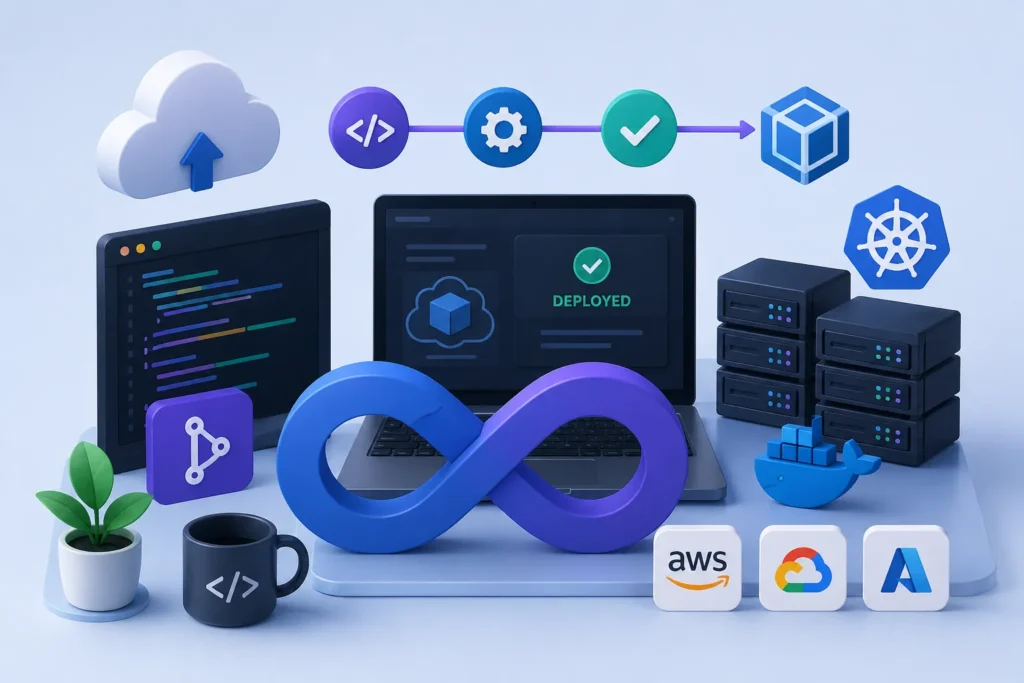
Reading about these tools is a first step. Some things do make a difference:
- Create real projects, not tutorials. Run an actual app through a complete pipeline, from code commit to running app in the cloud.
- Take advantage of free cloud computing credits from the major providers to try out real-world applications without first having a job.
- Have a current GitHub profile. Your activity is much of an interest to employers as is your resume.
- Pick a cloud platform and a cloud orchestration tool that you excel in, and don’t be multi-cloud or multi-tool. Many prefer to read and be impressed by depth rather than superficial knowledge.
DevOps vs. SRE vs. Platform Engineering
Such roles overlap and job titles differ considerably from one business to another. DevOps is more general in its scope as a culture and an automation of the development to production pipeline, SRE is more targeted on system reliability and incident response, whereas Platform Engineering is more targeted on creating internal tools and infrastructure other engineering teams use.
